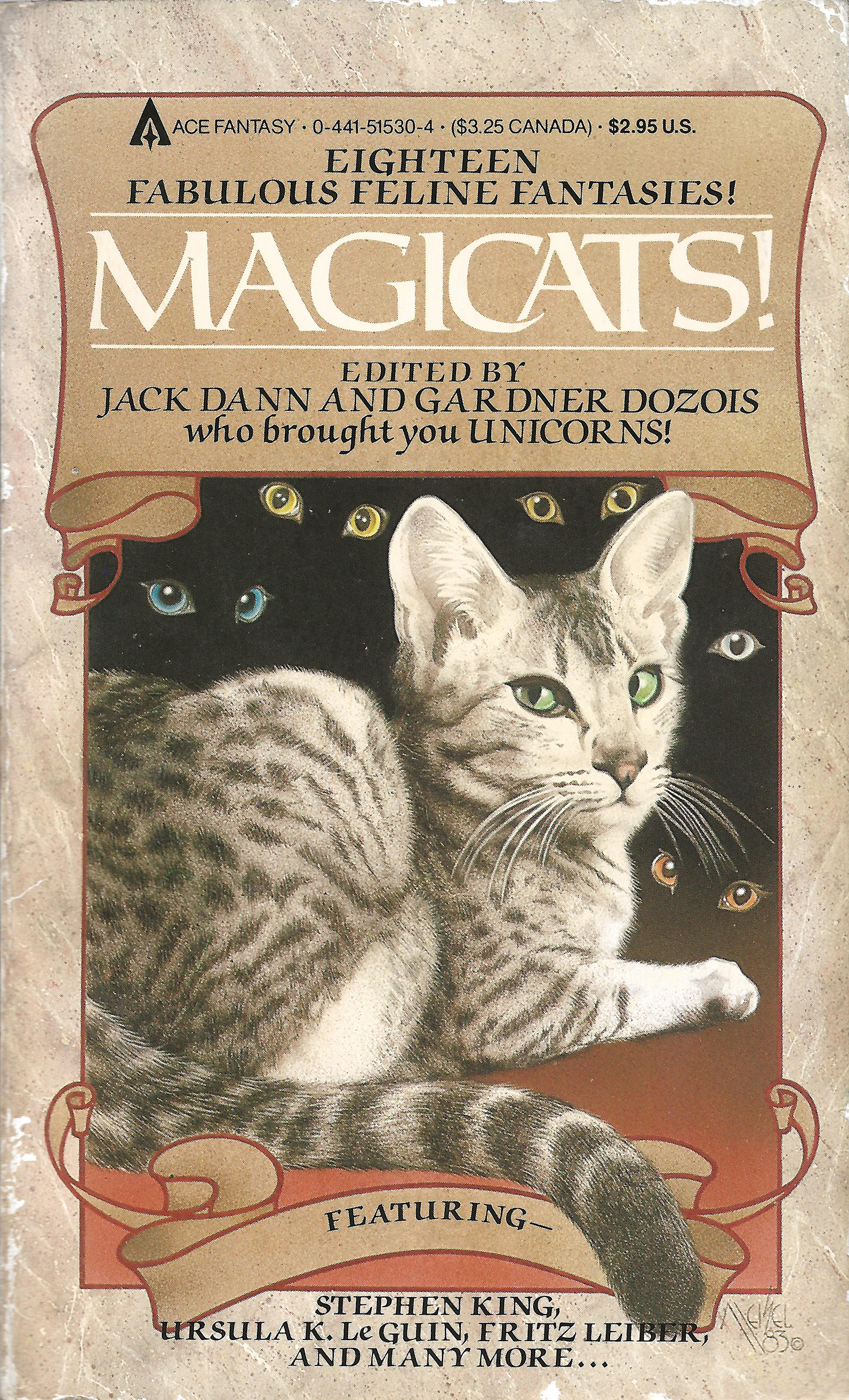
Magicats!
Editors: Jack Dann and Gardner Dozois
Authors: Fritz Leiber, Cordwainer Smith, Stephen King, Pamela Sargent, Ursula K. Le Guin, Ron Goulart, Henry Slesar, Byron Liggett, Terry Carr, Carol Carr, Knox Burger, Edward Bryant, Gary Jennings, Gene Wolfe, Manly Wade Wellman, John Crowley, Randall Garrett, Gardner Dozois, Jack Dann, and Michael Swanwick
Published: June, 1984 by Ace
Cover Artist: Ann Meisel
Publisher Blurb: Magical stories from science fiction and fantasy's greatest writers
Fey cats
Funny cats
Deadly cats
Cats that dreams are made of
Cats to haunt your nightmares
Magicats!
Notes: Like a lot of animal anthologies of this nature, many of the stories involve cruelty to animals that ranges from really graphic violence to comic-action violence visited on monsters. In the summaries below I try to include some 'sensitive nature' descriptors after the stories in brackets. Don't read what's in the brackets if you don't want spoilers. I personally am really affected by more violent stories, and because of that this anthology is certainly not among my favorites, although a few of the stories are very much worth reading. Some of these stories are also old enough to be available online/in the public domain, and I'll link to those that I can find. This book is currently out of print, but a used copy is worth picking up for the beautiful covert art if you're a collector of such things.
Summaries:
Content in brackets contains information about sensitive content for those who want to avoid the more violent/distressing stories; these may count as spoilers so don't read unless you're prepared for that.
The anthology is also labeled as science fiction and fantasy, but there are horror stories represented, too (as can probably be guessed by the inclusion of a Stephen King story). I'm including the genres individual stories fall under for readers who want to skip the horror.
"Space-Time for Springers" (1958) by Fritz Leiber
Available for free online: https://faculty.uca.edu/rnovy/Leiber--SpaceTime%20for%20Springers.htm (with several pieces of art from the original publication not included in Magicats!)
Genre: Psychological horror, fantasy
The cheerful, intelligent, and energetic kitten Gummitch has big plans for life. For starters, he's expecting that any day now he'll transform into a human and take his rightful place among them. He isn't sure how this transformation will happen, but it might have something to do with coffee. The only thing standing in his way is a young child acting out maliciously-- and dangerously-- against her infant sibling, leaving Gummitch in an unfortunate place regarding his own transformation. One of the more well-written stories in this collection, "Space-Time for Springers" is an engaging but ultimately sad story about the innocent delusions of grandeur of childhood and how they might be bitterly disappointed. [Psychological violence; this one didn't involve a literal death of animals but it's sad enough that I teared up a little myself, and it's certainly a downer. But I'm particularly sensitive to violence against non-human animals so I imagine I'm in a small percentage of readers who are distressed by it.]
"The Game of Rat and Dragon" (1955) by Cordwainer Smith
Available for free online: https://www.gutenberg.org/files/29614/29614-h/29614-h.htm (with some beautiful illustrations from the original publication not included in Magicats!)
Genre: Speculative fiction
In the Instrumentality of Mankind, interstellar travel can be deadly. Out there in empty space where strange beings prowl and prey on travelers, the intelligence of human telepaths paired with the quick hunting instincts of cats allow ships to move safely across the lightyears. This story introduces Underhill, a human telepath, and his partner, the cat Lady May, and takes us through one such perilous journey across space. An otherwise interesting speculative story-- transplanting rat-hunting ships' cats to spaceships in the far future-- ends on a stupid note with some of Cordwainer Smith's typical jabs at women. (Frankly, I prefer the company of my cats to human men myself, so maybe Underhill and I have an understanding.) [No cats die; the only animal deaths are of the abstract and alien 'dragons' or 'rats' (depending on if your perspective is human or feline).]
"The Cat From Hell" (1977) by Stephen King
Available for free online: https://xpressenglish.com/our-stories/cat-from-hell/
Genre: Horror, paranormal, possibly splatterpunk
The hitman Halston is hired on an unusual assignment: take out an allegedly evil cat. Thinking that the man hiring him has simply lost his marbles-- after all, Drogan is old and has a guilty conscious due to his involvement in laboratory animal testing-- Halston takes the cat away, prepared, with some regret, to do the deed. It's Stephen King, so the cat is in fact supernatural after all. The cat kills Halston by climbing into his mouth and xenomorphing himself out of the body and then runs off, presumably to take care of Drogan. [Mass animal death is mentioned, ie the maltreatment and destruction of an enormous number of cats used as test animals in a laboratory; human deaths also mentioned, ie the cat's first victims; the described death that takes place during the story is of a human character; implied human character death after the closing of the story. The death that takes place during the story is very graphically described.]
"Out of Place" (1981) by Pamela Sargent
Available for free online: https://zoboko.com/text/vgwx6n3j/the-year-of-the-cat-the-complete-collection-the-year-of-the-cat/118
Genre: Speculative fiction, perhaps psychological horror
Without warning, humans can suddenly hear the thoughts of other animals. Marcia first notices the phenomenon with her cat Pearl, whose thoughts, typically catlike, are mostly about eating and grooming and enjoying life. In response to this newly acquired telepathy, killing and butchering food animals becomes impossible and vegetarianism takes off. But while cows and pigs are off the hook, some companion animals aren't so lucky: they know all the details of their humans' private lives, and they equally don't know how to keep secrets. [Includes a scene with domestic violence perpetrated by a husband against a wife; animal deaths also described, including the shooting of a dog.]
"Schrödinger's Cat" (1974) by Ursula K. Le Guin
Genre: Speculative fiction, literary fiction
A surreal journey through a world where everything is decohering, our unnamed narrator tries to make sense of a universe-- and a life-- that are literally falling apart. The narrator eventually opens a dialogue with someone who is quite possibly a dog. Here, it becomes vitally important to answer Schrödinger's perennial question of the cat who may or may not be alive... or exist at all. Certainly the most literary tale in the anthology, and an interesting and whimsical story. [As for animal death? Well, we don't know. The cat disappears.]
"Groucho" (1981) by Ron Goulart
Genre: Fantasy, humor (?)
Buzz Stover is a Hollywood script writer, though not a particularly good one. He can only come up with something worthwhile when he's working with is assistant, Warren Gish. Unfortunately, Warren is recently deceased and Stover is about to lose his career. He works a little desperate black magic and pulls Warren back into the realm of the living... but, unexpectedly, into the body of a house cat. Warren remembers his former life and his former partner, and agrees to team up with Buzz Stover-- at least until a better opportunity comes along. [A human awareness displaces a cat awareness, I guess would be the best way to describe the situation here? Then Warren, as a cat, is violently and graphically killed. A human character also dies.]
"My Father, the Cat" (1957) by Henry Slesar
Available for free online: https://www.gutenberg.org/files/28119/28119-h/28119-h.htm
Genre: Fantasy, fairytale
In the tradition of a fairytale, Etienne is the son of a human woman and an exceptionally intelligent cat. Also in the tradition of a fairytale, Etienne's mother dies when he is a young child, leaving him to be raised by his feline father Dauphin. He loves his father dearly, and looks forward to introducing his fiance Joanna to him. Dauphin, however, is wiser to the ways of humans than Etienne is and warns that it would be disastrous to share his unusual heritage with her. [No animal deaths. Death mentioned regarding Etienne's human mother.]
"The Cat Man" (1960) by Byron Liggett
Genre: Horror
How many cats is too many cats? A successful writer purchases a private island as an authorial refuge and takes a lot of intact cats, male and female, with him for companionship. They immediately do the predictable thing and begin to breed. Having cleared the island of its native rodent population, they're soon starving to death. They turn on any humans approaching the island, as well as their erstwhile benefactor, in a desperate search for food. [A lot of cats die. Dogs die. So does a human.]
"Some Are Born Cats" (1973) by Terry and Carol Carr
Genre: Fantasy, humor
There's something decidedly uncatlike about Alyson's cat Gilgamesh. Her other cat, George, seems normal enough, but Gilgamesh just seems to be... off, somehow, as if he never quite got the hang of being a cat. Alyson and her friend Freddie pose different theories, but the most likely explanation, they decide, is that he's an alien spy from a distant planet. When strange things begin happening around town, they may get to find out. [No animal deaths.]
"The Cat Lover" (1961) by Knox Burger
As the introduction to this story mentions its grisly nature, I skipped this one. Considering that up to this point in the collection, we've already seen a story where a cat gets brained ("Groucho") and multiple stories with massive amounts of animal deaths ("The Cat From Hell", "Out of Place", and "The Cat Man"), I figured I didn't want to bother with it.
"Jade Blue" (1971) by Edward Bryant
Genre: Future fantasy
The scientist/inventor Obregon has been working on a time-editing machine in his private laboratory, making his home a prime target for sabotage. Meanwhile, his very young nephew, George, whose parents have abandoned him to Obregon's distracted care, lives in the estate and is raised by a cat-person named Jade Blue who acts as his nurse and governess. George is threatened and attacked nightly by shadow vampires-- manifestations of a past trauma real enough to cause harm. Jade Blue would do anything to protect him, and Obregon's time-editing machine looks promising. This odd little story contains some surreal elements of world-building that don't have much explanation or follow-up or purpose; it reads like an episode taken out of a novel and adapted to a short story. [No cats die. And there aren't even really any cats. Human death. Trauma faced by a young boy character prior to the story's start includes parental abandonment and implied sexual assault perpetrated by a governess against him.]
"Tom Cat" (1970) by Gary Jennings
Genre: Humor
Tom is a lay-about who has no desire to work but every desire to dwell among the rich and famous. To that end, he's been waiting for his elderly rich aunt to kick the bucket so he can claim an enormous inheritance. When she updates her will to leave her fortune to her cat Puffpuss, he must take desperate measures-- like pretending to be a cat-- to make ends meet. [No cats die.]
"Sonya, Crane Wessleman, and Kittee" (1970) by Gene Wolfe
Sonya and Crane, aging and lonely, strike up an unusual and shallow relationship that Sonya hopes will grow into something more (Crane's wealth may have something to do with it). She almost gives up, however, when she arrives at his house for the first time and discovers he shares his life with Kittee, the descendent of humans whose germline was edited with animal material (possibly cat, possibly gibbon, possibly dog-- no one is sure anymore). Kittee, essentially a companion animal in the shape of a human, does not bode well for Sonya's relationship with Crane. [No cats die... another story with no actual cats, though. Human dies.]
"The Witch's Cat" (1939) by Manly Wade Wellman
Available for free online: https://en.wikisource.org/wiki/Weird_Tales/Volume_34/Issue_4/The_Witch%E2%80%99s_Cat
Genre: Fantasy
An evil witch, Jael, terrorizes a town, as well as her own familiar-- a neglected little cat named Gib. But as a familiar, Gib has some special talents of his own-- and his feline love for home might be just the thing to make a difference in his community's well-being. [No cats die, but cat is subject to abuse. Human dies.]
"Antiquities" (1977) by John Crowley
Genre: Fantasy
A bar story, in which the narrator's friend recounts a story of a 'plague' of infidelity caused by a curse of Bastet, tied to stolen artifacts. [No cats die. Also no cats in the story.]
"A Little Intelligence" (1958) by Randall Garrett
Genre: Murder mystery
A group of aliens comes to stay at a convent on Earth. During their stay, one of their party and the protagonist's cat Felicity are murdered. It's up to Sister Mary Magdalene to expose the murderer and prevent a diplomatic incident. [The cat dies, along with a human-adjacent alien.]
"The Cat" (1983) by Gene Wolfe
Genre: Future fantasy, ghost story
Told by the steward Odilo as a household rumor, this ghost story recounts an event in which a young girl, Sancha, throws her pet cat into some sort of device capable of transporting beings between dimensions or realms. The cat physically disappears, but remains as a sort of ghost at Sancha's side. Years later, while a fourteen or fifteen year old girl, Sancha becomes involved in a scandal (in other words, she's raped by a man twice her age) and is sent away to avoid fallout. Many decades later she's able to return to her home, still accompanied by her ghostly cat. I have not read Wolfe's novels, including those for the milieu this story is set in, so a lot of the world-building doesn't have context for me; this story is ultimately about that world and its political relationships, and doesn't have a lot of interest outside of it. [The cat doesn't exactly die, but does become a ghost of sorts. Human dies. Instance of statutory rape perpetrated by a man in his thirties against a girl who is fourteen or fifteen.]
"Afternoon at Schrafft's" (1984) by Gardner Dozois, Jack Dann, and Michael Swanwick
Genre: Fantasy, humor
In this cute and silly story, a put-upon feline familiar has his revenge upon his wizard by refusing to help him remember a spell; chaos ensues. [No cats die.]