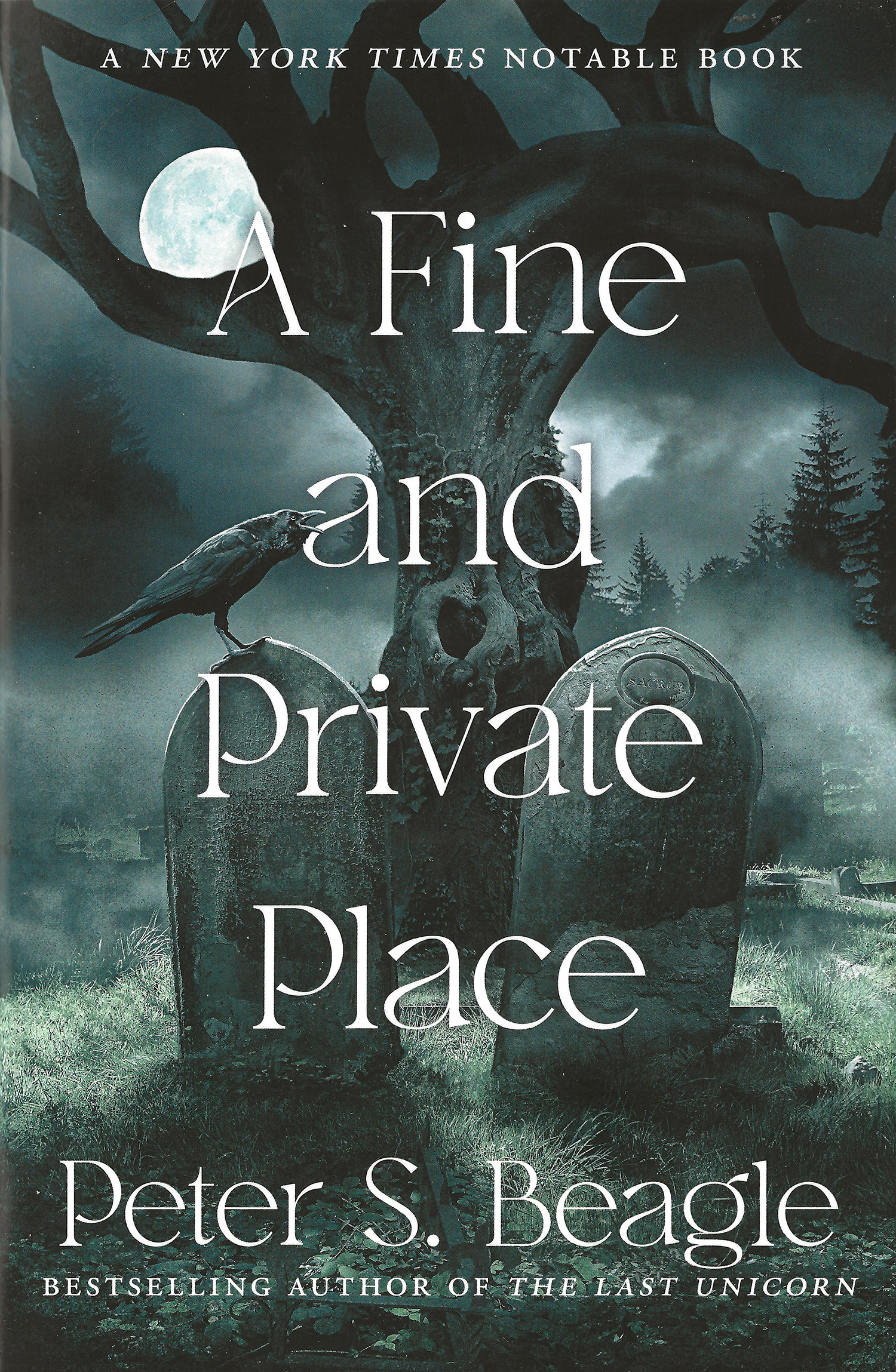
A Fine and Private Place
Author: Peter S. Beagle
Published: October, 2024 by Saga Press; originally published 1960 by Viking Press
Cover Artist: Not credited
Publisher Blurb (Viking Press edition): For nineteen years, Jonathon Rebeck has hidden from the world within the confines of a Bronx cemetery, making an abandoned mausoleum his secret home. He speaks with the newly dead as they pass from life to wherever spirits finally go, providing them with comfort, an understanding ear, and even the occasional game of chess.
But Mr. Rebeck's reclusive life is disrupted. An impossible love has blossomed between two ghosts at Yorkchester Cemetery. Helped along by a cynical, talking raven and a mysterious security guard, these souls must learn the true difference between life and death and make choices that really are forever.
Told with an elegiac wisdom and beauty, Peter S. Beagle's first novel is "one of literature's most beautiful works about ghostly times and places... told with wit, charm, and a sense of individuality" (The New York Times Book Review).
Notes: Peter S. Beagle's first published novel, which does not at all read like a first novel, is a contemplative ghost story that doesn't feel too slow or too heavy, but neither does it feel too sentimental or cute. Beagle strikes a really nice balance between melancholy and joy, thoughtfulness and humor, for a tale that's bittersweet and hopeful in a very uncontrived way.
Summary: A Fine and Private Place opens with a clever, talking New York City raven arriving in a cemetery with a stolen baloney. The baloney is for his human friend, Johnathon Rebeck, who relies on the raven's regular food thefts for survival, because he hasn't left the cemetery in 19 years. Living in an abandoned mausoleum, Rebeck comforts the newly dead and provides them gentle companionship until they forget life altogether and become forever quiet in their graves. He is comfortable in this self-imposed exile, where he exists somewhere between the living and the dead, not quite in either world. Just as the spirits of the dead cannot leave the graveyard where their remains are buried, neither can Rebeck go beyond the iron gate.
"Yes," Mr. Rebeck said, turning back, "but if life is the only distinction between the living and the dead-- I don't think I'm alive. Not really."
"You're alive," the raven said. "You hide behind gravestones, but it follows you. You ran away from it nineteen years ago, and it follows you like a skip-tracer." He cackled softly. "Life must love you very much."
"I don't want to be loved," Mr. Rebeck cried. "It's a burden on me."
"Well, that's your affair," the raven said. "I got my own problems."
Peter S. Beagle, A Fine and Private Place
Into Rebeck's quiet, half-alive domain come the ghost Michael Morgan, determined to hang on to the memory of life for as long as he can; the ghost Laura Durand, who believes herself ready and even eager to cast off life but finds that she must take letting go slowly after all; and the widow Gertrude Klapper, who, visiting her deceased husband's mausoleum and encountering Rebeck by chance, brings with her the air of life and its daily rhythms.
The story focuses on the development of the relationships between these characters, and how the demands of both the living and the dead affect Rebeck. Michael struggles with the question of his death-- did he commit suicide, or did his wife Sandra murder him? Laura examines the things she wanted and didn't have in life, which largely come down to the desire to be seen and loved. Klapper moves along the journey from grief, in which her deceased husband seems to linger in her apartment, to the joy of a new life-affirming friendship with Rebeck.
The raven, meanwhile, as the only one of them who moves easily between the permeable realms of the dead and the living, brings news of Sandra's ongoing trial to the cemetery.
We follow the development of the relationships of these characters, leaving the cemetery for New York City where Klapper sees mortality all around: her aging grocer and her awkward conversations with his family; her elderly neighbors, who sit out on lawn chairs and refuse interaction with the world; the relationship with her sister she does not quite know how to approach; her own lack of direction. She struggles to let go of her husband, but she also brings stories of life to Rebeck during her visits to the cemetery by speaking of her many nieces and nephews.
Conflicted, beginning to wake up to his reality, Rebeck is discovered one night by the drunken night guard, Campos. Instead of kicking him out, Campos befriends him after a fashion. Campos, like Rebeck, can speak with the dead, and has become friends with Michael and Laura, too. Jealous and uncertain of what this might mean about himself, Rebeck questions if he's actually valuable to the recently dead. Does he not belong among them, after all? The two ghosts, Campos, the raven, and Rebeck pass the night together drinking, singing, enjoying the company. Rebeck, feeling an outsider, tries to belong. Wanting to watch the arrival dawn, he falls asleep and misses that brief moment that can never be repeated.
Klapper further stirs up his questions by trying to gift him a raincoat. This simple gift, rejected, kicks off a confrontation between the pair about their own difficulties with life and death, from Klapper's continual fixation of her late husband to Rebeck's stasis in the cemetery. After the caretaker informs them of the approaching closing hour, Rebeck walks Klapper to the gate. He sees her cross but refuses to leave.
Laura and Michael, lingering still as ghosts, work together on the business of remembering life... things that one can't remember, the other describes. Sharing these moments together, sharing the ugliness that has followed them into death, they fall in love-- or into the memory of love, perhaps-- and vow to spend whatever time is left to them with each other.
Sandra's trial draws to a close. Newly uncovered evidence points to suicide, and with this revelation Michael remembers the circumstances of his death: he poisoned himself, hoping to take Sandra down with him. His suicide, now confirmed, means he is no longer permitted his Catholic burial, and he will be exhumed and relocated not just to a different plot but to an entirely different graveyard. Bound to their own remains, Laura and Michael will be separated forever.
In the aftermath of the exhumation, Laura begs Rebeck to dig up her own coffin, to follow after Michael and bury her where she can reunite with him for however long their spirits might last. Rebeck refuses, proclaiming that he is just as unable to leave the cemetery as Laura herself; that what she's asking is a cruelty to him. Laura, grieving, leaves Rebeck.
In the end, Rebeck relents. Everything he has gone through-- with the ghosts, with Campos, with Klapper-- gets through to him, and he realizes, not at all convinced, not at all wanting to admit it, that he will leave the cemetery. He can no longer stay. Campos and Klapper help him dig up Laura's remains and load them into the caretaker's truck, Campos behind the wheel. Rebeck realizes that once he passes the gate, everything will end: he will never come back, he will never again hear the voices of the dead, he will never again see his friend the raven. Even if he were to try to return, he couldn't. The place he has occupied for nineteen years is closing its gate to him forever. He will go back into the world of the living, with all his confusion and uncertainty and fear, because, unlike Campos, who, like the raven, moves between the worlds of the living and the dead without being tied to them, he must go back to being alive while he can.